
The Representative of the Supreme Leader’s Office at the University of Kurdistan, during a walking event commemorating the 3rd of Khordad, stated:
The Epic of Khorramshahr was not a conquest of land, but a triumph of values
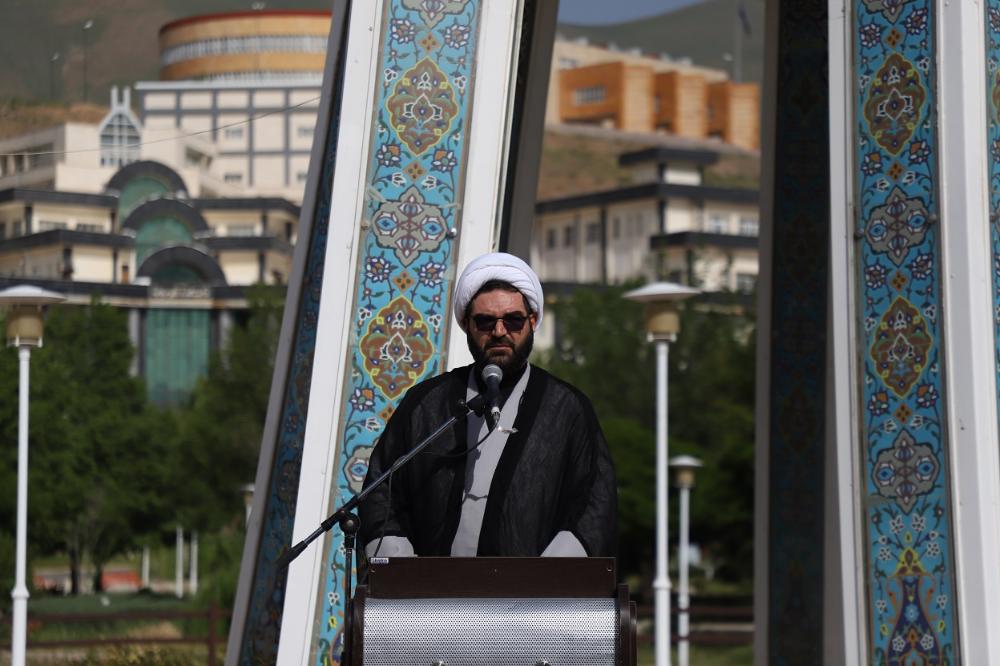



The Head of the Office of the Representative of the Supreme Leader at the University of Kurdistan stated: "The epic of Khorramshahr was not merely a conquest of territory, but a triumph of values—values that have formed the core components of Iran's contemporary resistance."
According to the Public Relations Office of the University of Kurdistan, Hojjat al-Islam wal-Muslimin Abedin Rostami spoke today, Sunday, May 24, 2026 (3rd of Khordad, 1405), during a university walking event held to commemorate the anniversary of the liberation of Khorramshahr. While honoring this auspicious day and offering condolences on the martyrdom of Imam Muhammad Baqir (AS), he noted that humanity is perpetually in need of counsel and ethical guidance. He stated: "In response to a seeker's request for counsel, Imam Muhammad Baqir (AS) provided a five-part testament, emphasizing that oppression must not be met with oppression, much like the composed manner in which Salman al-Farsi encountered an ignorant individual."
Hojjat al-Islam Rostami further elaborated on the other aspects of this narration, noting that Imam Baqir (AS) emphasized the necessity of "not responding to betrayal," "restraint in the face of denial," "avoiding narcissism when praised," and "steadfastness and patience against reproach."
Emphasizing that strong individuals align their character with internal values, he said: "Praise and applause should not make us arrogant, nor should we allow reproach and frowns to make us angry or restless."
Hojjat al-Islam Rostami continued by stating that Khorramshahr was the first chapter of the people’s operational resistance, adding: "Imam Khomeini (RA) always emphasized that there are three theories in the world: the theory of dominance, the theory of compromise and submission, and the theory of resistance."
The official from the Representative Office of the Supreme Leader at the University of Kurdistan, referring to the theory of compromise and submission, said: "Some believe that one must submit to a global system of dominance that wields power. However, Islam does not accept this approach; narrations state that both the oppressor and the one who accepts oppression without resisting are destined for damnation."
Hojjat al-Islam Rostami identified the theory of resistance as the only correct path, stating: "Imam Khomeini (RA) consistently emphasized resistance." He added: "Saddam, who launched the imposed war against Iran with the support of global powers, imagined he could conquer Tehran within a week, but this delusion reached a dead end through the resistance in Khorramshahr."
He further described this event as more than a military victory, calling it a symbol of resistance against the ideology of dominance and a triumph of values. He added: "As the martyred leader of the revolution stated, the conquest of Khorramshahr was not a conquest of land, but a conquest of values—values that constitute the primary elements of Iran's resistance today."
Hojjat al-Islam Rostami concluded by describing resistance as the natural right of every nation, stating: "Resistance carries costs, but undoubtedly, its costs are far lower than those of compromise."


Quick Links
Electronic Services
Useful Links


University of Kurdistan, Pasdaran Boulevard, Sanandaj, Iran

Postal Code: 6617715175

Phone: +988733664600-8

Email: info@uok.ac.ir


site visit
- today:
- yesterday:
- all:
Last Update
26 May 2026 - 04:46:37