
Information Technology Unit, Faculty of Basic Sciences
The 11th Seminar on Harmonic Analysis and Its Applications
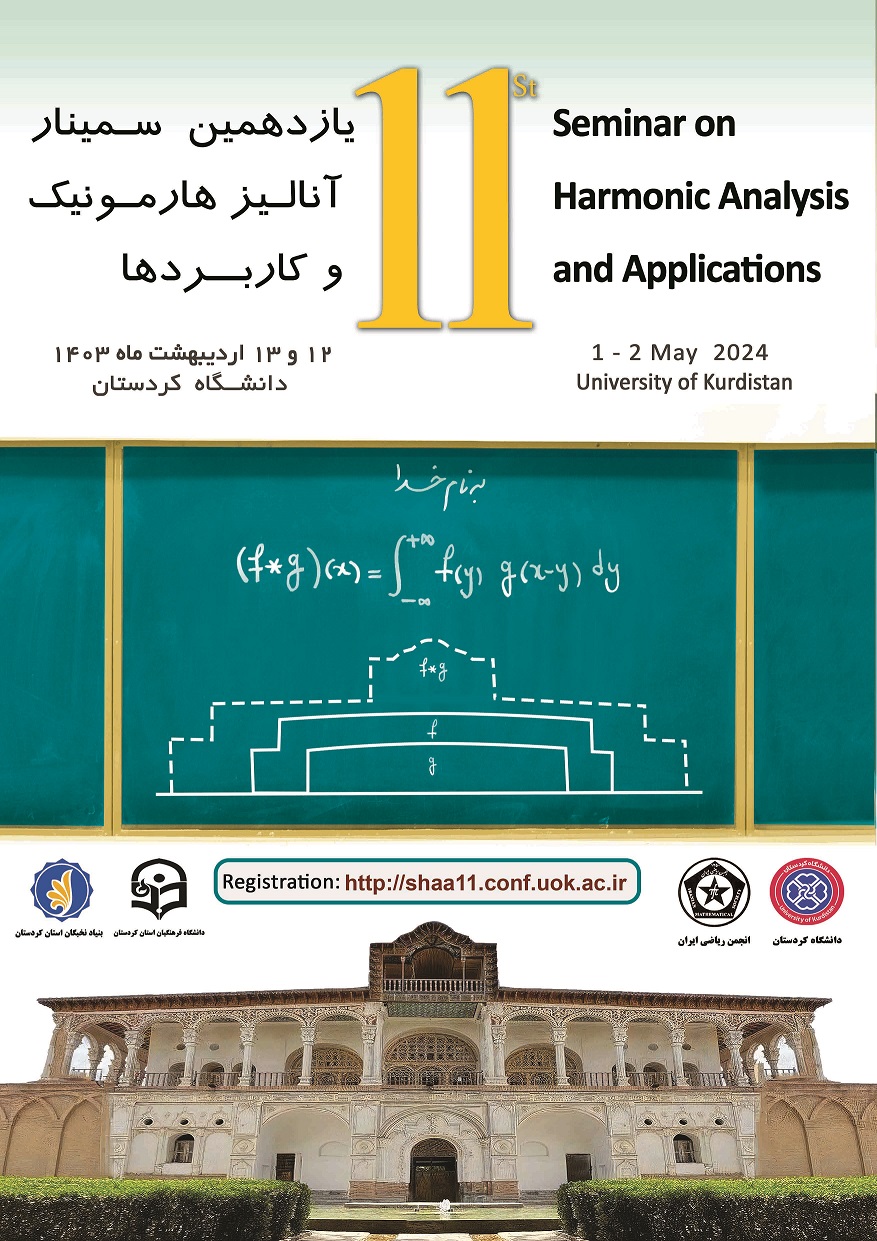



Harmonic analysis has made a significant contribution to the research interests of many faculty members and doctoral mathematics students in Iran, with a major portion of the educational and research activities in this field being conducted by Iranian mathematicians. Furthermore, this specialized domain not only covers numerous categories of mathematical topics and is linked to many others, but also finds meaningful applications across a wide and diverse range of sciences. Consequently, the necessity of creating an appropriate platform for scientific exchange and collaboration among experts in abstract and applied harmonic analysis led to the proposal of an annual seminar in this field. Approved by the Iranian Mathematical Society, the establishment of this scientific event since the beginning of the current decade aims to pave the way for enhancing the quantitative and qualitative standing of Iran as an international reference in the field of harmonic analysis and its applications.
The seminar's scope encompasses all theoretical and applied aspects of harmonic analysis, as well as related topics in other scientific disciplines, including:
-
Abstract Harmonic Analysis
-
Applied Harmonic Analysis
-
Classical Harmonic Analysis
-
Computational Harmonic Analysis
-
Topological Algebraic Structures
-
Fourier Transforms and Operators
-
Stability and Amenability
-
Operator Theory
-
Topological Groups
-
Lie Groups and Algebras
-
Locally Compact Quantum Groups
-
Banach and Topological Algebras
-
Locally Compact Hypergroups Theory
-
Frames and Wavelets Theory
-
Representation Theory of Algebras and Groups
-
Topological Semigroups
-
-
Applications of Harmonic Analysis
-
Image and Signal Processing
-
Dynamical Systems
-
Computer Science
-
Banach Spaces
-
Operator Spaces
-
Mathematical Physics
-
Probability Theory
-
Ergodic Theory
-
Measure and Integration Theory
-
Potential Theory
-
Approximation Theory
-
Control Theory
-
Theory of Equations
-
Homology and Cohomology
-

Faculty Systems

Student Systems

Staff Systems

Virtual Tour

Telephone Directory

Privacy Policy Statement
Quick Links
Electronic Services
Useful Links


University of Kurdistan, Pasdaran Boulevard, Sanandaj, Iran

Postal Code: 6617715175

Phone: +988733664600-8

Email: info@uok.ac.ir


site visit
- today:
- yesterday:
- all:
Last Update
19 Jul 2026 - 05:45:02